
How Cryptocurrency Mining Machines Work and What They Really Cost You
What a cryptocurrency mining machine does
A cryptocurrency mining machine is a computer system that participates in validating and recording transactions on a distributed blockchain ledger. The ledger works like a shared financial record: when one person spends cryptocurrency, one account is debited and another is credited. Because digital records can be manipulated more easily than physical cash or property, the network relies on cryptographic verification and, in many major cryptocurrencies, a consensus process that makes unilateral changes impractical.
So what is the purpose of crypto mining? It's not just creating new coins. Mining serves three related functions:
What crypto mining does
- It validates cryptocurrency transactions.
- It adds verified transactions to the distributed ledger.
- It helps prevent double-spending, in which the same digital currency is spent more than once.
New coins are generally issued as rewards to miners who perform the required validation work. Because distributed ledgers do not have a central authority, miners have an economic incentive to secure the network and follow its rules.
In a proof-of-work blockchain, computers compete to solve complex mathematical calculations in the form of cryptographic hashes. A hash is a shortened digital fingerprint of data. Hash functions secure data transferred across a public network. A mining machine repeatedly tests values until it finds a hash that meets the network's current target. The first miner to find the qualifying hash can add the next block to the ledger and receive the reward.
Each new block includes a cryptographic reference to the block before it, creating an unbroken chain that can be traced back to the first block. Other network participants can use this structure to check whether blocks are valid and whether miners completed the required work.
As more capable machines join the network, the difficulty of the calculations rises. Competition among miners consequently increases, and the scarcity of newly issued coins can rise with it. Hash rate is used as a measure of the computational work a machine or network can perform. Difficulty, hash rate, electricity consumption, and equipment cost are among the main variables affecting the probability of finding a valid hash and the economics of an operation.
Early cryptocurrency mining could be performed with a basic CPU in a home computer. Bitcoin mining has since become almost exclusively associated with highly specialized application-specific integrated circuit machines. The intermediate period produced a strong demand for graphics processing units, particularly when GPUs provided a practical way to mine currencies and participate in mining pools. Advanced Micro Devices reported strong financial results during that period, and its stock reached its highest level in a decade as demand for GPUs increased.
Bitcoin's early price history illustrated growing interest in the technology. In 2010, Bitcoin rose from fractions of a cent to nine cents. At the time of the semiconductor-shortage discussion, it had reached a reported all-time high of $68,000. Increased investment helped drive cryptocurrency prices, while public comments from billionaire Elon Musk contributed to a sharp rise in Dogecoin, described at the time as a joke currency. These developments increased attention to mining but also intensified competition for hardware and electricity.
CPU, GPU, and ASIC mining machines
A CPU is a general-purpose processor designed to handle many different types of tasks. In cryptocurrency's early days, Bitcoin and other cryptocurrencies could be mined with a simple CPU chip in a home computer. CPUs could also mine some later cryptocurrencies, including privacy-oriented coins such as Monero.
CPU mining has become impractical for many major cryptocurrencies because network difficulty has risen. A CPU may take months to accumulate even a small amount of profit after electricity and cooling costs are considered. A large number of CPUs would consume enough electricity to make many operations inefficient.
A GPU is specialized for rendering graphics and for parallel processing. Its ability to perform many calculations at once made it much more effective than a CPU for many early cryptocurrency-mining algorithms. A GPU mining rig combines multiple GPUs under one mining system. A motherboard and cooling system are required to support the rig.
Mining repeatedly tests combinations of letters and numbers in search of a target hash. In the simplified explanation used in early GPU-mining literature, changing one digit at a time produces a large number of possible combinations. The GPU's rendering and parallel-computation power allows it to test those combinations more quickly than a general-purpose CPU.
GPUs also contain arithmetic logic units, although some GPU-mining explanations incorrectly treated this as a feature unique to ASICs. Arithmetic logic units let both processors perform calculations; the relevant difference is how much calculation each type of chip is designed to perform for a particular workload.
A CPU is general-purpose, while a GPU is optimized for tasks that benefit from many parallel operations. A CPU can operate without a GPU, while a GPU normally works as part of a system that also has a CPU. For high-end graphics editing, visual effects, and related work, a CPU and GPU perform different parts of the overall task. The same division can make GPUs more useful than CPUs for mining algorithms with high parallelism.
GPU mining was described as more energy-efficient than CPU mining when power consumption and useful mining output were compared. Its disadvantages included the cost of acquiring multiple GPUs, the need for a motherboard and cooling system, and competition with other uses for graphics hardware.
GPUs have also been used in malicious mining. Monero's CryptoNight algorithm was designed to resist ASIC specialization and keep CPU mining feasible, while GPU miners can still provide substantial computational power.
An ASIC is a chip designed specifically for one task or a narrow class of tasks. A cryptocurrency ASIC is designed to perform a particular mining algorithm and produce more cryptocurrency units than a general-purpose GPU for that algorithm.
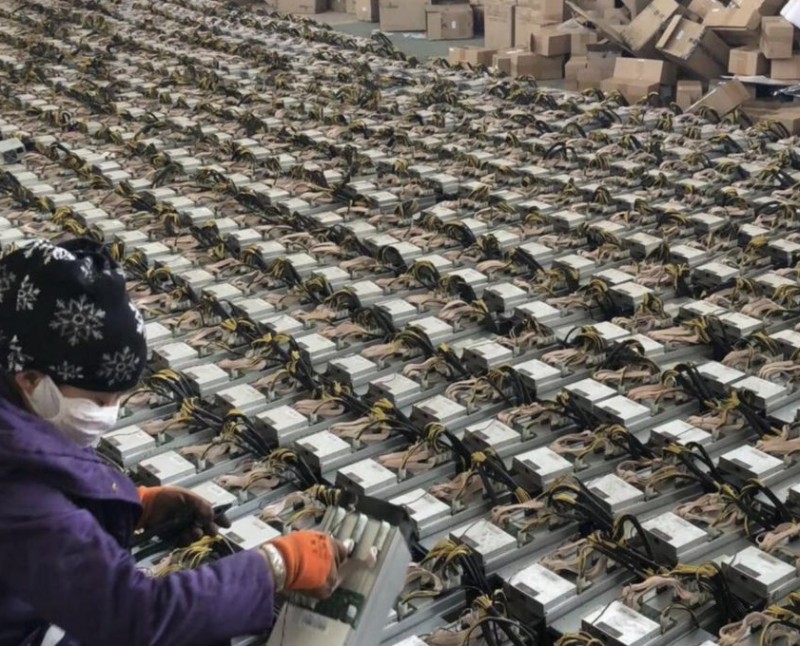
ASICs became dominant in Bitcoin mining because specialized hardware could perform the required hashes more efficiently. A large number of ASIC miners may be needed in a competitive operation, especially when mining difficulty and network hashrate are high.
The advantage comes with substantial costs:
ASIC mining costs
- ASIC miners are expensive to purchase.
- They are designed for a particular algorithm or coin.
- They can become obsolete or less competitive as mining difficulty rises.
- Mining revenue can fall while electricity and cooling costs remain.
- A specialized machine may have little value for other computing tasks.
The dominance of ASICs applies most clearly to Bitcoin. GPUs remained important in Ethereum and other networks whose mining algorithms benefited from flexible, high-parallelism hardware. GPUs also remained useful to criminals targeting Monero and other CPU- or GPU-friendly coins.
If you're wondering what is bit mining, it's the process of using specialized hardware to validate Bitcoin transactions and earn new coins. The best cryptocurrency miner for Bitcoin is an ASIC machine designed specifically for SHA-256 hashing. GPU mining can still work for other crypto coins to mine, but Bitcoin mining software almost always runs on ASIC hardware now.
"If 2017 was the year of ransomware, 2018 would be the year of crypto-jacking. This is the perfect cybercrime in many ways."
Comparing the main mining methods
CPU mining offers broad hardware compatibility and can work with some coins, but it is generally too slow for many major networks. GPU mining provides more parallel computing power and can be economically useful when a network's algorithm is suitable for GPUs. It requires several cards, a motherboard, and a substantial cooling system.
ASIC mining is purpose-built and can provide greater efficiency for a supported algorithm, but the machine is expensive, specialized, and exposed to obsolescence. Cloud mining avoids the need to own and operate the machine locally. It involves renting mining capacity from a company or facility for a specific period. Cloud mining is the most hands-free option described in the source material, although the rental terms, provider, duration, and available hashing capacity determine the cost and risk.
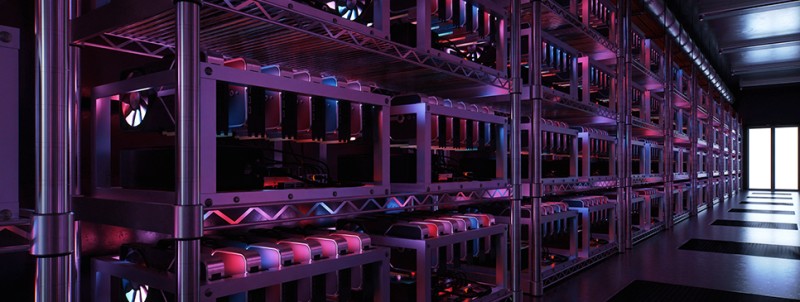
For people starting out, the best crypto miners for mining at home are typically GPUs or CPUs, depending on the coin. ASICs are powerful but expensive and noisy. A crypto miner farm setup requires serious infrastructure: power distribution, cooling, and reliable internet.
Mining software, internet access, and mining pools
Mining requires specialized software designed to solve the relevant cryptographic calculations. A mining rig also needs a reliable internet connection and normally participates in an online mining pool rather than mining alone.
Bitcoin mining software connects your hardware to the network and handles the technical work of submitting shares and receiving rewards. A mining pool combines the computational resources of multiple miners. The group's combined hashrate gives it a greater chance of finding a block. If the pool succeeds, the reward is divided in proportion to the resources contributed by each participant. Participants may receive different shares for different types of work, but the general economic principle is that more contributed computing power should produce a larger share of the pool reward.
Official mining pools are often regarded as more reliable than informal pools because their host companies may provide software upgrades and technical support. Miners can also form their own pools or move between pools. CryptoCompare was identified as a place where miners could compare pools by factors such as reliability, profitability, and supported coin.
The more performance a computer can produce, the greater its chance of finding a winning hash. This relationship is especially important in a large mining pool where thousands of machines may be competing. Small differences in uptime, storage responsiveness, network latency, cooling, and power settings can affect performance.
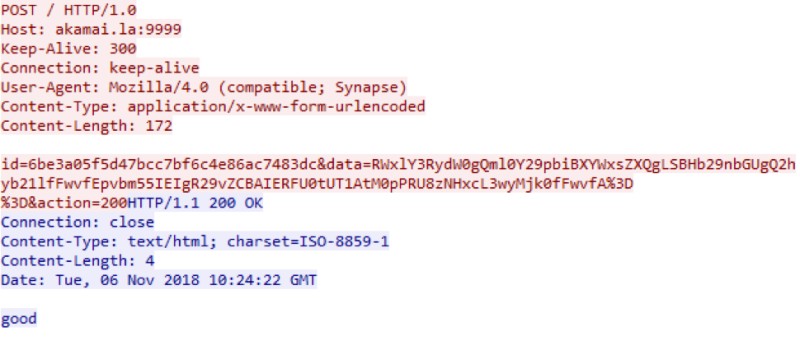
Mining attacks often use the Stratum protocol to communicate with a pool. In a typical pool-mining session, client software sends a subscription request over TCP or HTTP/S. The pool then sends publish messages to subscribed clients. These messages use readable JSON-RPC structures. A subscription request includes fields such as id, method, and params. This structure can help security systems identify unencrypted Stratum traffic.
Profitability and total operating costs
The purchase price of a mining machine is only one part of its cost. The most important economic factors include:
What affects mining profitability
- Hash rate
- Electricity consumption
- The local price of electricity
- Cooling requirements
- Mining difficulty
- Pool reliability and fees
- Machine availability, maintenance, and downtime
- The price of the cryptocurrency being mined
- Storage and networking needs at larger scale
- Taxes and regulatory obligations
Crypto-mining machines consume considerable electricity and produce significant heat. One estimate stated in the source material is that an average ASIC miner uses about 72 terawatts of power to create a bitcoin in about ten minutes. That figure was already expected to change as mining technology and difficulty advanced.
Another cost example used a $1,200 mining-hardware investment and $2 in daily mining profit. If the coin's value did not rise, the hardware would take approximately two years to pay off that purchase price. The same example stated that mining was not profitable at an electricity cost of 14 cents per kilowatt-hour. These figures are examples rather than universal rates; profitability changes with hardware, network difficulty, energy prices, and cryptocurrency prices.
GPU and ASIC operations require cooling in addition to electricity. Cooling can involve air-conditioning, fans, filtration, ventilation, evaporative cooling, water cooling, or dielectric immersion cooling. Immersion and water systems were noted as growing in popularity but were outside the scope of one Bitcoin-facility airflow discussion.
Professional miners who receive the strongest rewards are described as continually studying new technologies and optimizing their machines and operating strategies. At the same time, difficulty rises as more efficient hardware is deployed, so a machine that is profitable today may lose that status later.
A mining operation can be described economically in terms of the relationship among machine output, power expense, and cryptocurrency rewards. If electricity or cooling expense rises faster than mining revenue, profitability declines even when the machine's measured hash rate remains stable. Downtime caused by overheating, hardware failure, malformed software, network problems, or storage bottlenecks can produce the same effect.
Cooling and why miners throttle
ASIC mining converts electrical energy into thermal energy. The energy moves from the ASIC chips to heat sinks, and fans or other cooling systems move that heat away from the components. ASIC miners are programmed to reduce or throttle their hash rate when hashboard temperatures become too high and to shut down if a safe operating range cannot be maintained.
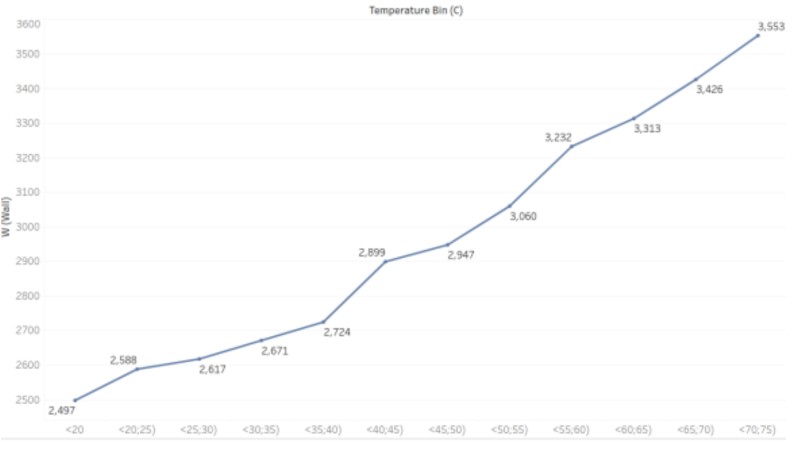
Research from Braiins cited in a Bitcoin-facility guide indicated that mining efficiency in joules per terahash could improve by as much as 30% with better cooling. One example showed efficiency changing from 24 joules per terahash at 20°C to 34 joules per terahash at 75°C while hash rate remained constant. The machine was therefore using more energy for the same output at the higher temperature.
Appropriate ventilation also reduces air-filter maintenance and limits condensation-related equipment damage. Cooling design affects downtime, repair costs, component life, and operating expense. In a competitive mining business, the lower power required per unit of hashing output can improve the difference between revenue and electricity cost.
Exhaust airflow
Most ASIC miners can operate with intake air below 100°F without expensive air conditioning, although local climate and machine specifications still matter. Their hot exhaust air is commonly around 130–180°F.
The central airflow requirement is to prevent hot exhaust from flowing back into the machine intakes. Total facility exhaust should equal the combined exhaust airflow of all miners. For example, a facility requiring 100,000 cfm of total exhaust could use five 20,000-cfm exhaust fans.
Exhaust capacity must be supported by enough fans to remove the heat rather than allowing it to accumulate in the building. If exhaust flow is inadequate, intake temperature rises, machines throttle, and efficiency falls.
Intake openings and filtration
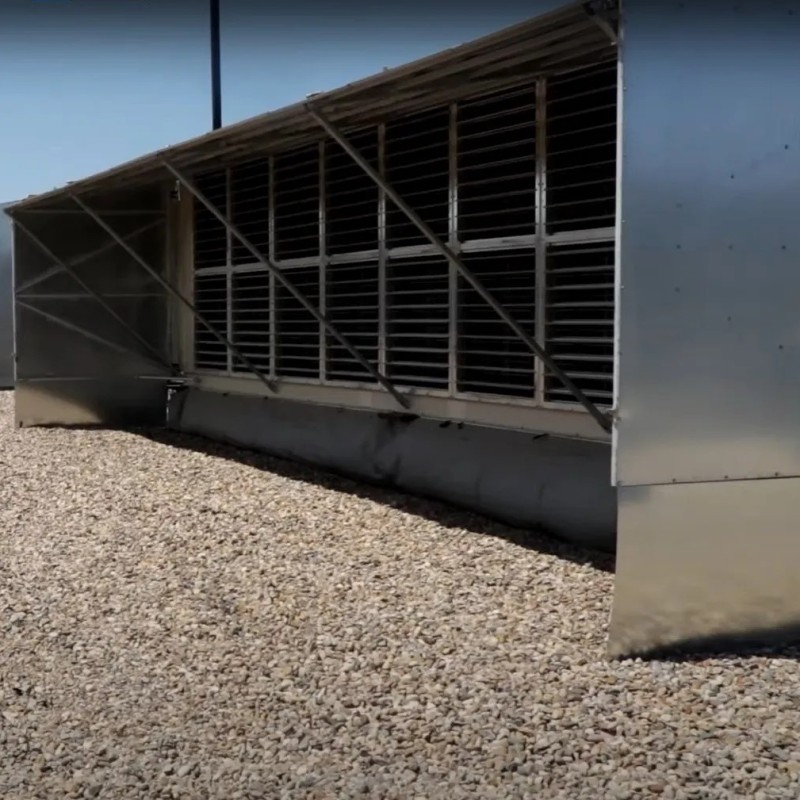
A mining facility needs intake openings large enough to supply the ASICs with the required airflow. Intake openings commonly use louvers or awnings to reduce the entry of rain and snow. They also require filters and screens to keep out insects, dust, pollen, and other foreign material.
Louvers alone were described as insufficient protection against rainfall in some designs. Newer facilities often combine intake louvers with extended roof overhangs or awnings. A larger intake area can also reduce air velocity, turbulence, precipitation intrusion, and filter-maintenance frequency.
Thick pleated filters can increase intake surface area and free-area ratio. One intake arrangement uses multiple parallel rows of wall-mounted awnings, with the filtered opening beneath each awning. Compared with a single wall intake, this arrangement offers more intake area and faces downward, which can improve the exclusion of dust and pollen.
Evaporative cooling
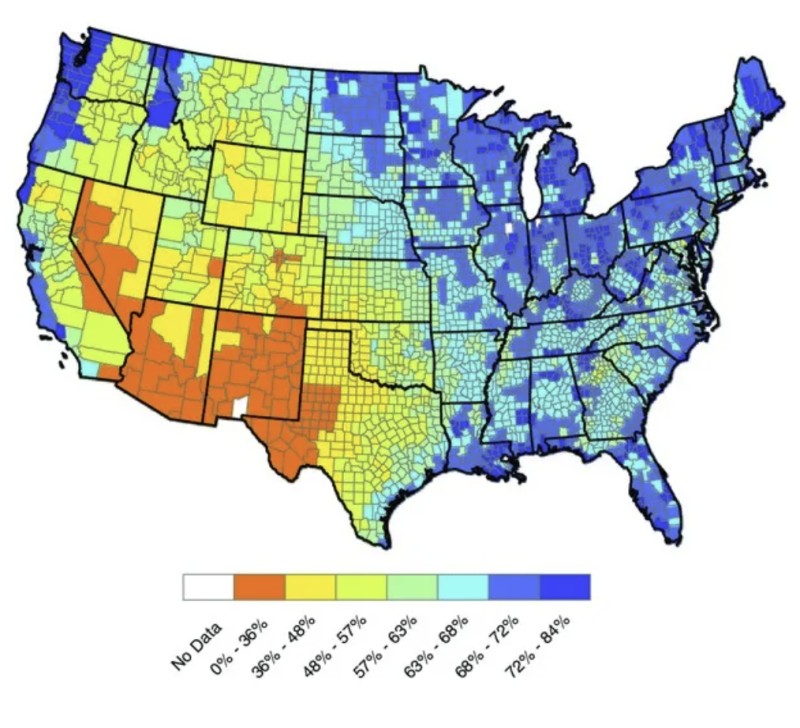
Many ASICs are designed for intake temperatures below 100°F, but some mining regions can reach 120°F during summer. Evaporative cooling can reduce intake temperature by approximately 15–30°F.
The process draws hot, dry outside air through water-soaked cooling pads. As water evaporates, heat is removed from the air and the air temperature falls. The method uses the adiabatic effect of evaporation and consumes less energy than compressor-driven mechanical air conditioning. Its operating costs were described as potentially up to 80% lower.
Evaporative cooling's effectiveness depends heavily on humidity and temperature. Hot, dry air produces the greatest evaporation and cooling. The process is less effective in coastal climates and during rainy periods with high humidity. Regions in the orange and yellow areas of the cited United States humidity map were identified as likely to receive the greatest benefit.
Evaporative cooling raises the relative humidity of intake air. ASIC manufacturers generally recommend keeping facility relative humidity below 90% to avoid condensation damage. Even hot, dry locations may need to reduce or stop evaporative cooling during cold, rainy weather.
Separating hot and cold air
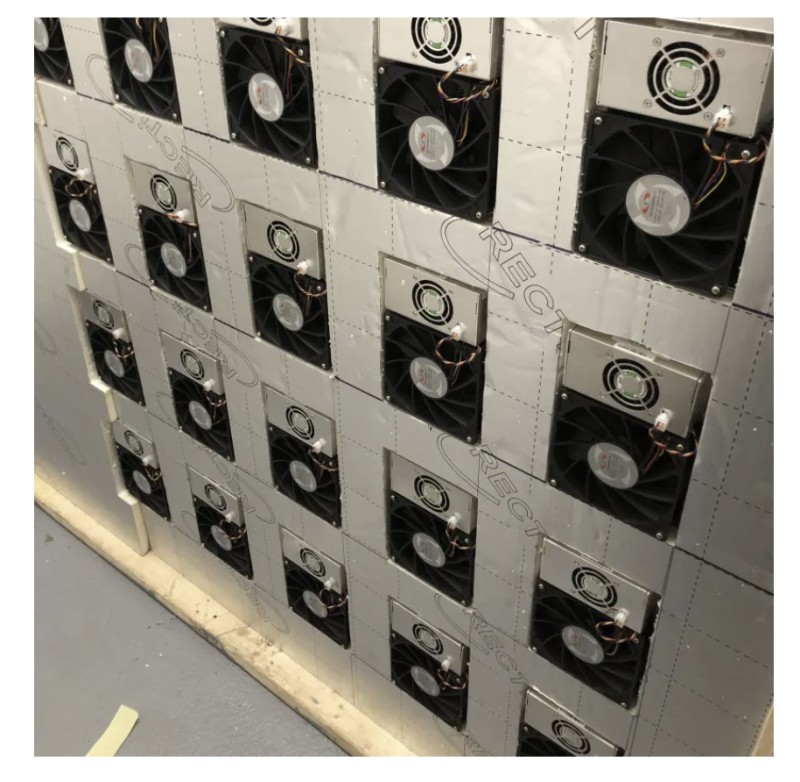
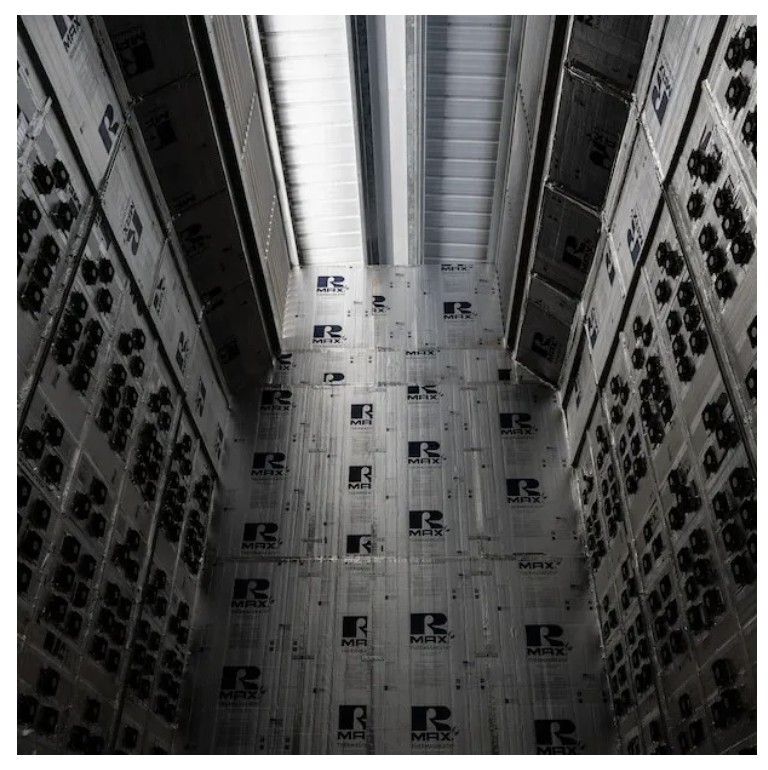
ASICs operate most efficiently with cool intake air, so exhaust air should not mix back into the intake side. Insulation-based air barriers can prevent this recirculation. This arrangement is called hot-aisle containment.
Foam-board insulation from construction and home-improvement stores can be used for this purpose. Because the primary heat-transfer mechanism in air mixing is convection rather than conduction, the R-value and thickness of the insulation are less important than preventing the air streams from mixing.
Humidity, condensation, and hot-air recirculation
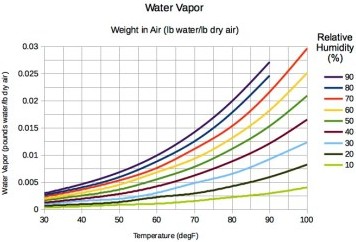
High humidity can create several problems in a mining facility. Snow can be drawn into the building during winter storms. Moisture can condense when relative humidity reaches its dew point, when air temperature falls, or when pressure changes.
Although operating ASICs produce substantial heat, pressure fluctuations inside a miner can still cause condensation at high relative humidity. A malfunctioning or idle miner may remain cool and become more vulnerable than a fully loaded machine.
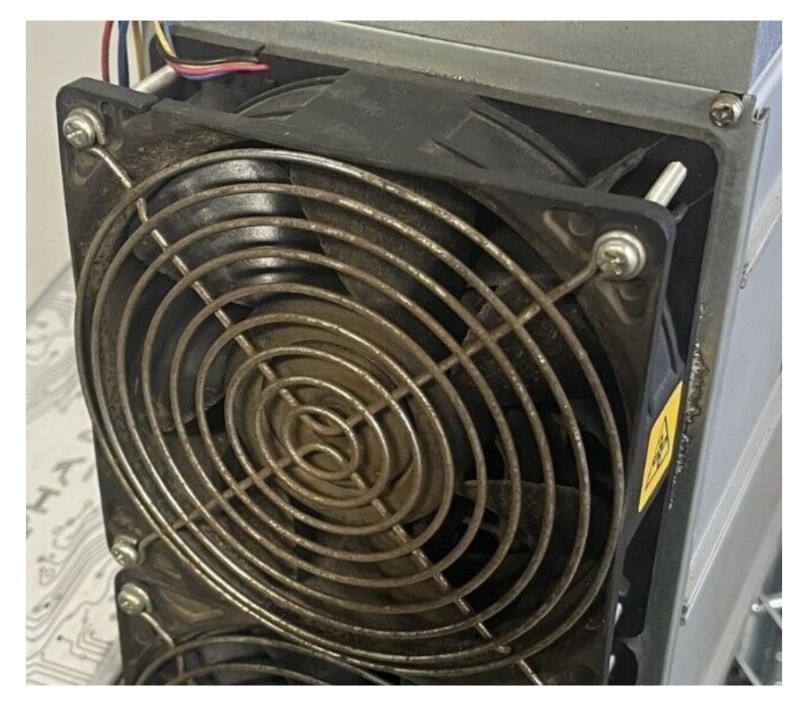
Moisture can damage more than the ASIC hashboards. It can affect power distribution units, power supplies, control boards, switchgear, and other electrical equipment. Rust appearing on an ASIC intake-fan grill was identified as an early visible sign of a facility moisture problem.
A simple way to lower the relative humidity of incoming air is to heat it slightly by mixing it with a controlled amount of hot exhaust. Air at 60°F and 90% relative humidity, for example, falls to approximately 75% relative humidity when heated by 5°F.
This process is called hot-air recirculation. It can be created by leaving controlled gaps in the separation barrier so that a limited amount of exhaust enters the cold-air side. Too much recirculation raises intake temperature and lowers mining efficiency in joules per terahash. An automated system can regulate backflow according to intake temperature and humidity.
Facility layouts
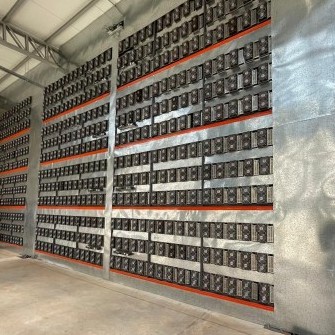
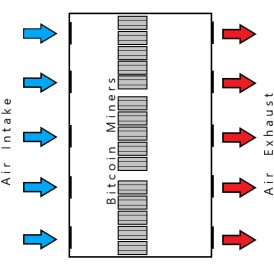
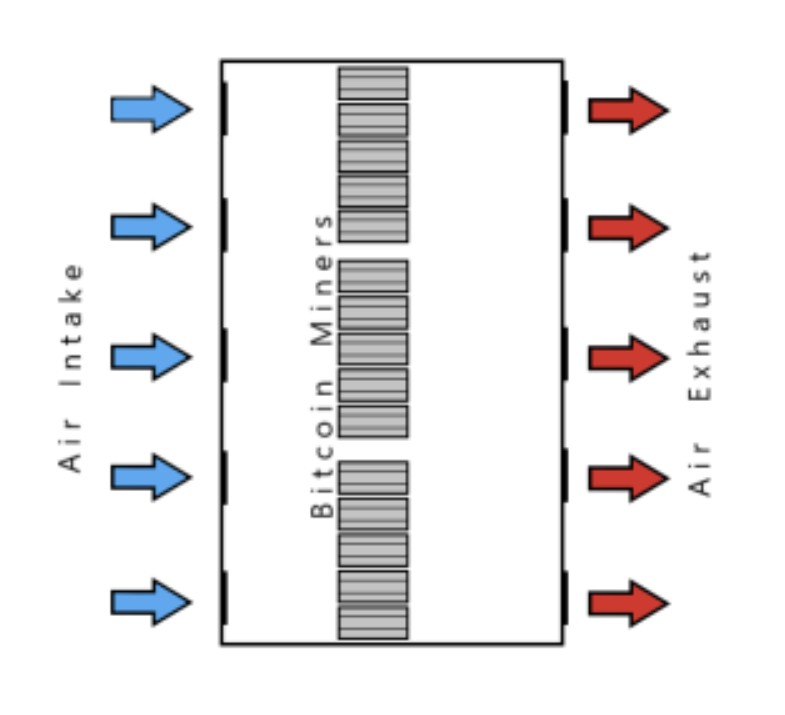
A simple mining-facility airflow design resembles a wind tunnel. Cool air enters from one side, passes through a row or wall of miners, and exits through the opposite wall. Exhaust fans remove the hot air and prevent it from accumulating.
The negative pressure produced by the miners and exhaust fans can draw cool air into the building without separate intake fans. This arrangement is common in small and medium mining operations below 2 megawatts and is also used in shipping-container designs.
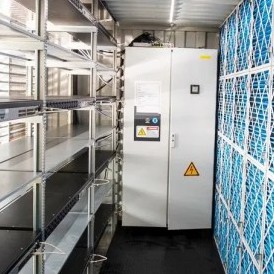
Roof-exhaust layout
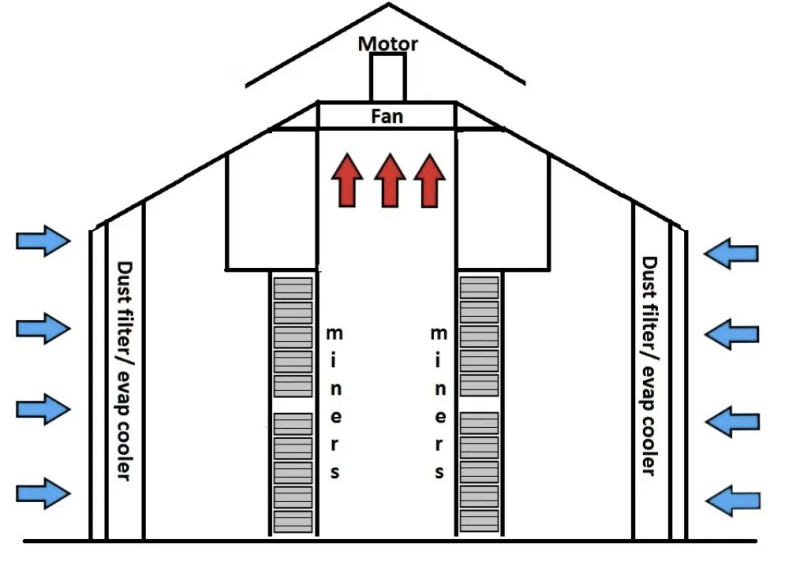
Roof-mounted exhaust fans are common in larger facilities above 5 megawatts. Hot air naturally rises, allowing it to be discharged through the roof. This permits intake openings on both sides of the building and can support greater miner density.
Roof-vented systems are generally more capital-intensive to build and maintain than basic wall-exhaust systems.
Exhaust-fan drives
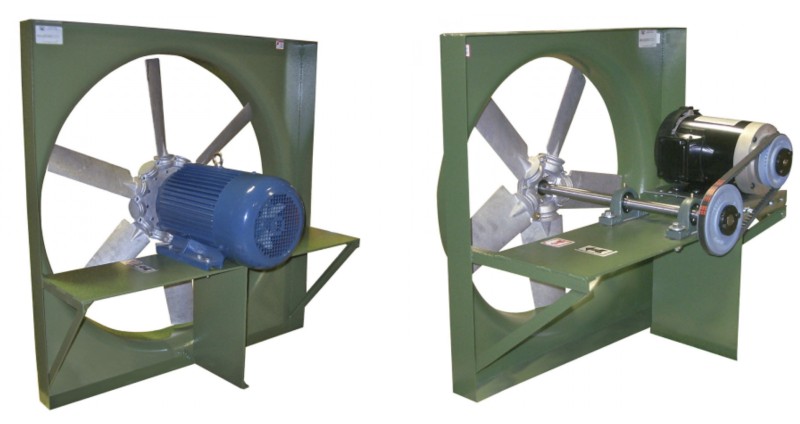
Direct-drive and belt-drive fans are the two principal fan types used in mining facilities.
Direct-drive fans have fewer components because they do not use sheaves, belts, or bearings. They generally require less maintenance and were described as the more popular option.
Belt-drive fans are common for propeller fans larger than 36 inches. Large belt-driven systems are often more cost-effective, and their drive packages can provide more flexibility for adjusting fan speed.
Recovering exhaust heat
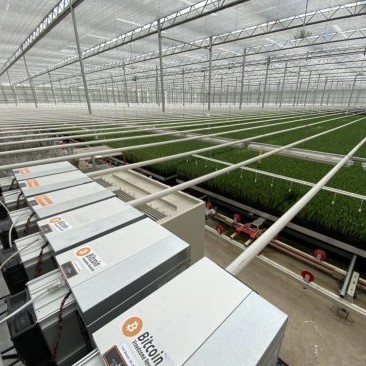
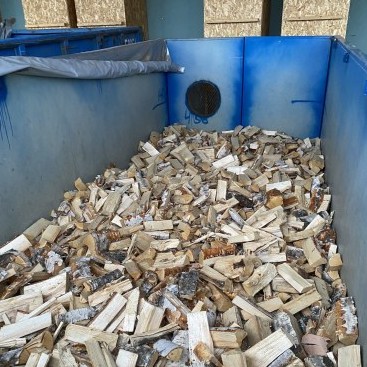
Traditional facility designs treat hot exhaust as waste heat and discharge it. Bitcoin miners have also used exhaust heat for drying wood, dehydrating produce, heating water, and supporting aquaculture. A greenhouse in the Netherlands and a wood-drying operation in Norway were given as examples.
Heat recovery can create an additional revenue stream and offset part of mining operating costs. Conventional Bitcoin-facility layouts do not readily support heat recovery, so specialized engineering is required to capture and transport the heat.
Mining-facility buildings
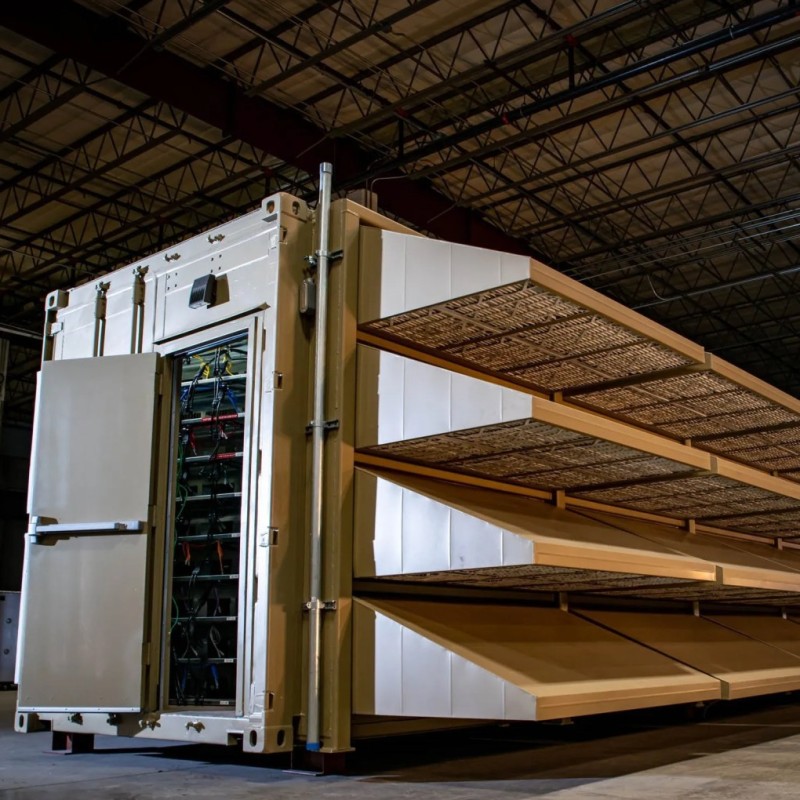
Shipping containers are an affordable, portable, and durable option for a mining farm. Existing metal buildings, sheds, and outbuildings can also be adapted. Airflow recommendations and calculations can be applied to full buildings, mining pods, and containers.
A basic facility schematic has a cool-air intake side, a miner bank, and a separate hot-air discharge side.
Storage and infrastructure for large mining pools
Mining is competitive because thousands of computers may be trying to win the reward for the next block. Any performance that can be removed from an infrastructure bottleneck can improve the probability of finding a winning hash. This becomes especially important when a mining operation runs tens, hundreds, or thousands of nodes.
A cryptocurrency node needs compute, network, and storage resources. It also needs cluster-management software to automate deployment and monitoring. Docker and Kubernetes can package node software, deploy it across a cluster, keep it running, and manage connections between nodes.
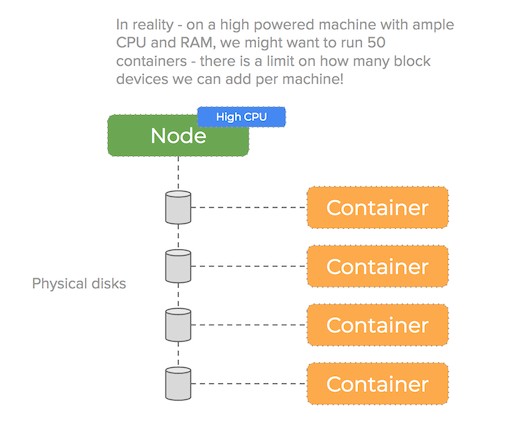
Blockchain applications are stateful. A full cryptocurrency ledger can be large, and each node or container may need its own writable copy. This creates a storage problem in addition to the compute requirement.
The blockchain ledger grows over time. The Bitcoin ledger was reported as 149 gigabytes in December 2017, with a prediction that it would continue growing into terabytes as adoption and payment activity increased. Each exchange, mining tool, wallet, or other cryptocurrency application may need to store the entire blockchain it validates.
Performance is important because the mining process is a continuous race. A small read/write bottleneck can delay access to the ledger and reduce a machine's effective performance. Ordinary NFS-like network storage was considered unsuitable where low latency is paramount.
Several storage practices were identified for mining infrastructure:
Storage practices for mining infrastructure
- Use SSDs instead of spinning disks because SSDs have higher input/output operations per second.
- Keep disks local to the compute node to reduce network read/write latency.
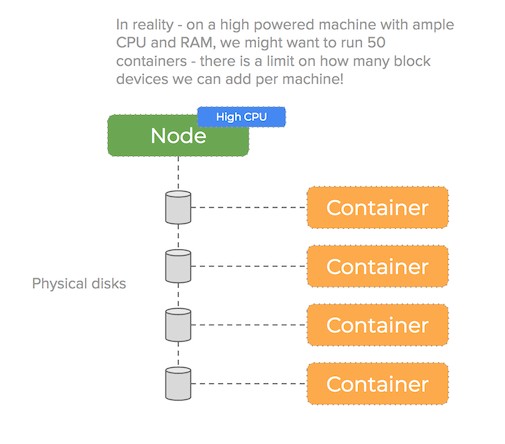
- Do not assign an entire physical disk to every container when high container density is required.
- Use cloud-native software-defined storage that can manage multiple nodes and containers.
- Use a dedicated SSD or NVMe journal device for metadata when the storage provider supports it.
- Use the I/O profile suited to the application.
- Place compute workloads on the same host as the blockchain ledger, a hyper-converged arrangement.
A single Linux virtual machine has a limited number of available block devices. AWS was cited as having a limit of around 40, making one disk per container difficult when many containers must share a high-core-count machine. A software-defined storage layer can pool the underlying disks and present virtual volumes to containers without assigning each container a dedicated physical disk.
Journal devices and I/O profiles
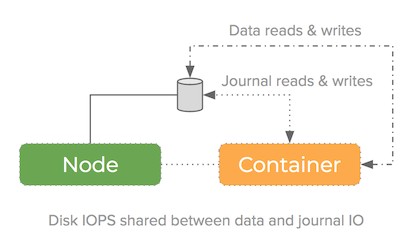
A filesystem turns the byte sequence on a disk into files and folders. A journaling filesystem also writes metadata, known as journal data, so that it can recover after a power failure or another interruption.
If file contents and metadata use the same physical device, they compete for the same I/O operations per second. A second block device can serve as a journal device, allowing metadata and file-data operations to use additional I/O capacity in parallel.
Portworx was described as supporting a second block device for this purpose. In a large cluster, adding a journal device across nodes can increase the I/O operations available to all container volumes on the affected node.
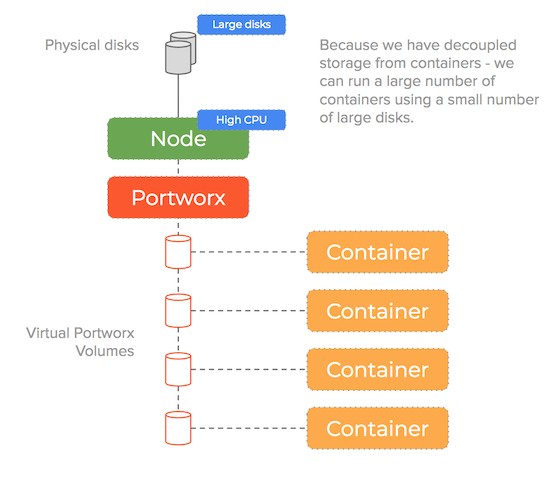
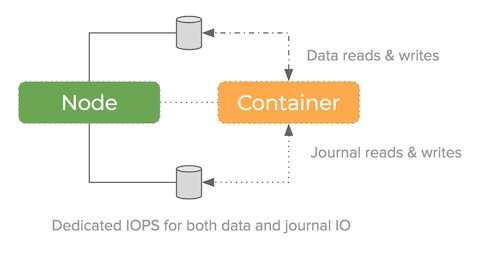
Portworx was also described as a cloud-native software-defined storage system that works with Docker and Kubernetes. It is cluster-aware, can use a single storage system across thousands of nodes, and creates a storage pool from the underlying disks. Decoupling storage from containers allows more containers to run on the same compute host without immediately reaching a storage-operational bottleneck.
Volume-level performance profiles can alter how storage handles I/O:
Portworx I/O profiles
-
io_profile=sequentialoptimizes read-ahead for sequential access. -
io_profile=randomrecords recent access patterns and adjusts read-ahead and data layout for short-term random I/O. -
io_profile=dbuses write-back flush coalescing to combine multiple synchronization operations occurring within a 50-millisecond window into one synchronization operation. Coalesced operations are acknowledged only after copying to all replicas. This mode requires a minimum replication or high-availability factor of three and assumes that all replicas do not fail from a kernel panic or power loss at the same time within that 50-millisecond period.
Proof of Stake and the Ethereum Merge
Ethereum is a decentralized, open-source blockchain with smart-contract functionality. Its September 2022 transition from proof of work to proof of stake was known as the Merge.
On September 15, 2022, the Ethereum blockchain reached block height 15,537,394, the target set for activation of Proof of Stake as the network's block-validation and decision-making mechanism. The transition followed years of work by Ethereum developers and other participants in the open-source project.
In the proof-of-work model, miners use electricity-powered machines, often running around the clock, to compete for blocks. In the proof-of-stake model described in the source material, validation depends on stake in the system rather than the same type of intensive computation. A home laptop was described as sufficient for basic participation in validation under proof of stake, while Ethereum validators separately have to commit funds.
The Merge was the final part of an Ethereum roadmap that had been planned for almost five years. Similar proof-of-stake systems were already used by projects such as Solana and Avalanche. Proof of stake was described as supporting considerably higher transaction throughput, one of the main limitations of proof of work. With no mining calculation required for validation, a blockchain can produce larger blocks at a controlled pace.

Ethereum was also important as an economic and development platform. Ether was described as the second-largest cryptocurrency by market capitalization, behind Bitcoin, and as the native asset of the Ethereum network. Approximately $164 billion was estimated to be invested in the ETH ecosystem.
A Bank for International Settlements report was described as showing ether representing about 30% of banks' cryptocurrency exposure, making it second only to Bitcoin. The World Economic Forum described Ethereum as a technological pillar for thousands of Web3 projects and 71 million Ethereum-based cryptocurrency wallets. Tether, a major liquidity asset on cryptocurrency exchanges, was included among the token ecosystem cited in connection with Ethereum.
Before the Merge, Ethereum's proof-of-work network distributed more than US$10 million per day to the mining community. This reward helped drive a sharp increase in graphics-card prices. Nvidia captured a large share of the profits and rose into a group of highly profitable global companies.
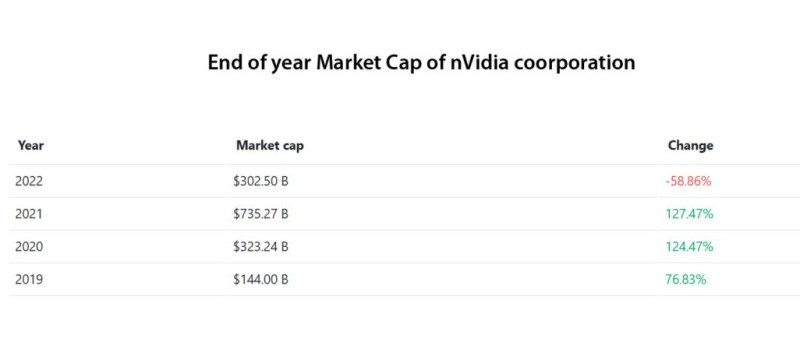
After Ethereum announced in October 2021 that the final stage of proof-of-stake integration was ready, Nvidia's share price and market value fell sharply. A reported market-cap chart showed a decline from approximately $735 billion to $302 billion and described a 58% reduction during 2022. The same discussion attributed a $380 billion loss in 2021 to the decline following the Merge announcement.
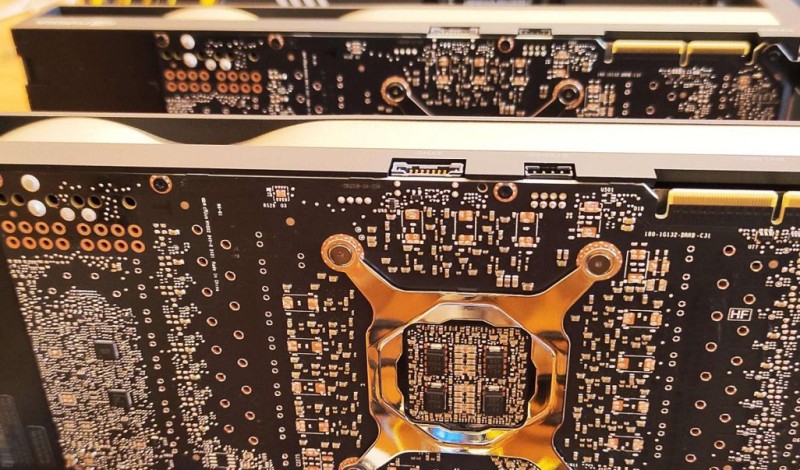
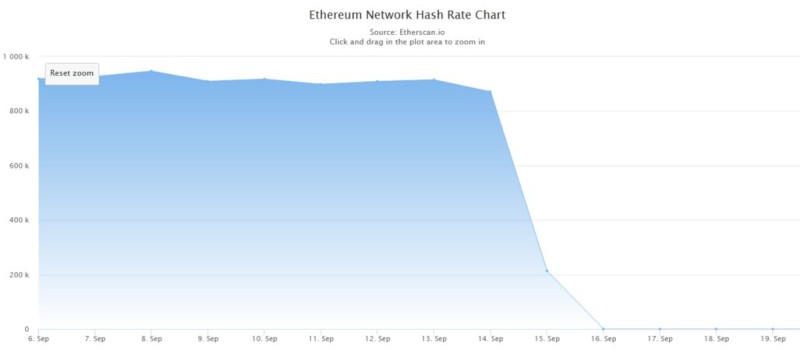
Hundreds of thousands of Ethereum miners stopped their machines after the Merge. Mining systems containing motherboards and Nvidia or AMD graphics cards were disconnected from the electricity supply, and the Ethereum network's hash rate dropped sharply.
The reported reduction in electricity use appears in two forms in the source material: 99% in the short description and 99.8% in the detailed account. The transition was promoted as a switch to a green, energy-efficient blockchain-security mechanism, and media outlets and think tanks reported it as a major development in the debate over proof of work and proof of stake.
The Merge was also described as marking the end of personal or home-grown Ethereum mining. Large mining farms running GPUs lost their previous proof-of-work role, while proof-of-stake validation changed the relationship between network participation, capital, and block rewards.
Proof-of-work, proof-of-stake, and energy
Proof-of-work proponents argue that electricity consumption represents the cost of the work required to secure a blockchain. Bitcoin is described by some supporters as an "energy-backed asset," and they view its energy use as part of the asset's security model.
Proof-of-stake proponents argue that proof of work wastes energy and is incompatible with a sustainable future because the same security could be obtained without continuous, intensive computation.
Governance is another point of difference. In proof-of-work systems, miners compete on relatively equal terms and spend electricity to validate work. In the proof-of-stake model described in the Ethereum discussion, validation passes from miners to network users or entities with substantial stake. This has been compared with existing financial systems in which well-capitalized institutions act as trusted parties.
A synchronous decision mechanism remains necessary because all nodes must agree on the blockchain's latest state. Proof of stake changes how agreement is reached, but it does not remove the need for network participants to follow a common validation state.
Governments were also considering the energy and environmental effects of proof-of-work mining.
In 2021, China introduced a ban on Bitcoin and proof-of-work mining. China had previously hosted a large share of the world's Bitcoin miners. Mining operations in some provinces were supplied with electricity from coal mines, and advanced mining data centers were associated with additional carbon emissions. The Chinese action was described as an effort to reduce emissions.
In September 2022, the White House issued the report "Climate And Energy Implications Of Crypto-Assets In The United States." The report called on the cryptocurrency industry to develop sustainable solutions consistent with United States climate objectives. It had been initiated by President Joseph Biden's March 2022 executive order, "Ensuring Responsible Development of Digital Assets." Both documents identified proof-of-work mining as a main issue to address in meeting climate goals.
The European Union considered amendments to the proposed Market in Crypto-Assets regulation, or MiCA, intended to prevent or restrict proof-of-work mining. The proposal did not receive the required approval at the time of the account.
Some proof-of-work supporters argue that mining can use electricity that would otherwise be wasted and can provide a constant source of demand that helps stabilize the electrical grid. The opposing position is that blockchain security does not require energy-intensive computation and that proof-of-stake can provide comparable validation with substantially less electricity consumption.
Regulatory consequences of the Ethereum transition
The change in Ethereum's structure affected the way regulators viewed ether holdings and distribution. The US Securities and Exchange Commission had previously stated that Ethereum's 2014 initial coin offering was not a security offering and that it would not pursue participants, citing the network's decentralized nature.
One day after the Merge, SEC Chairman Gary Gensler told the Senate Banking Committee that more than 60% of ether was held by entities in the United States and therefore potentially under SEC jurisdiction. The source material connected this figure to proof-of-stake rewards and raised the possibility that participants receiving newly created assets could be treated differently under securities or money-transmission rules.
To become an Ethereum validator, a person or entity must deposit 32 ether, described at the time as worth approximately $35,000. The funds are placed in a locked, non-movable vault, and the depositor receives a share of the rewards issued for new blocks. This process is called staking.
More than 200,000 people and businesses opted to stake after the Merge. Because custody of cryptocurrency and smart-contract assets remains operationally complex, most funds were described as being staked through Coinbase. Coinbase was identified as the second-largest cryptocurrency exchange and the first publicly traded cryptocurrency company.
Without naming Ethereum directly, Gensler told the Senate Banking Committee that proof-of-stake cryptocurrencies appeared similar to securities investments and should fall under SEC jurisdiction.
Taxation of mining rewards
Mining creates two distinct taxable events in the United States:


Comments on “How Cryptocurrency Mining Machines Work and What They Really Cost You”
No comments yet. Be the first to share your thoughts.