
What Blockchain Is, How It Works, and When You Actually Need It

What Blockchain Is
I started digging into what is blockchaining because the term gets tossed around like a magic wand. At its core a blockchain is a shared digital ledger that records transactions or any digital fact across a network of computers. It’s also called distributed ledger technology or DLT. The ledger is replicated, distributed, chronologically linked, append‑only, cryptographically secured, consensus‑driven, auditable, tamper‑resistant, resilient, and programmable. Those ten properties show up in every description I’ve read.
Core properties of a blockchain
- Shared or replicated ledger
- Distributed across many nodes
- Chronologically linked blocks
- Append‑only record
- Cryptographic verification
- Consensus mechanism
- Shared source of truth
- Auditable history
- Tamper resistance
- Resilience through multiple copies
- Programmability via smart contracts
Blockchain replaces trust in a central institution with trust in cryptography, software, economic incentives, and a consensus process.

How Blocks, Hashes, and Nodes Work
A block holds a batch of transactions or records, a hash of its own data, and the previous block’s hash. That previous hash is the link that chains blocks together. The hash function is one‑way and deterministic: same input always yields the same fixed‑length fingerprint, and you can’t reverse it. Changing a single character changes the hash, which breaks the link to the next block. Nodes are the computers that keep copies of the chain, validate transactions, and help reach consensus. Some nodes just watch, others produce blocks.
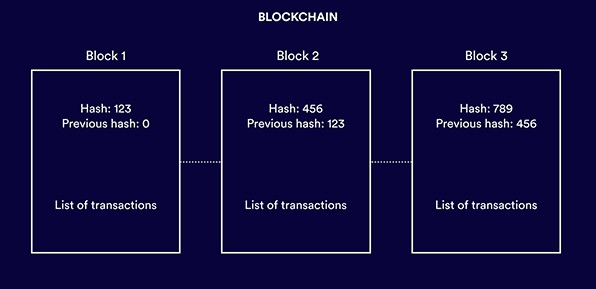
In a proof‑of‑work system miners try billions of nonce values until the block hash meets a difficulty target. That “golden nonce” proves work was done. The cost of re‑mining an old block and all later blocks makes retroactive changes expensive. This is the basics of how does blockchain technology work in a mining network.
Public Keys, Private Keys, and Digital Signatures
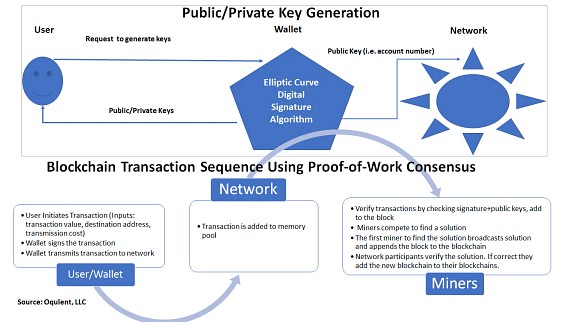
Cryptography does two jobs here. Hashes lock the data order. Public‑key crypto authorizes who can spend or write. A private key is a random secret held by a wallet; the public key (or its hash) acts like an account address. When you sign a transaction with the private key you create a digital signature that anyone can verify with the public key. Only the holder of the private key can produce a valid signature, so the network knows the transaction was authorized. This setup lets people transact without a custodian, but it also means losing the private key loses the funds forever.
Consensus and Validation
Consensus is the rule set that lets strangers agree on the ledger state. Proof‑of‑work was first, used by Bitcoin. Miners compete to solve a hash puzzle; the winner proposes the next block and gets a reward. Proof‑of‑stake picks validators based on staked tokens and is far less energy hungry. Proof‑of‑authority relies on a known set of validators. Proof‑of‑history orders events with a verifiable time source. Directed acyclic graphs arrange transactions as a graph instead of a single line. Each method trades off speed, decentralization, finality, and hardware needs.
Common consensus approaches
- Proof‑of‑work
- Proof‑of‑stake
- Proof‑of‑authority
- Proof‑of‑history
- Directed acyclic graph
Cryptography is about replacing trust with mathematics.
Incentives and Cryptoeconomics
Validators need a reason to behave honestly. In many chains they must lock up stake; if they cheat they lose part of it (slashing). Users need a reason to adopt the network instead of a central service. Fees, block rewards, and token economics shape those incentives. The term what is cryptocurrencies and how does it work often leads to talk of “cryptoeconomics” - using incentives to guarantee application behavior. Incentives don’t replace validation rules; they just make following the rules the rational choice.
Public, Private, and Permissioned Blockchains
Not every blockchain is open to the world. Public (permissionless) chains let anyone run a node, submit transactions, and read the ledger. Private chains are run by a single organization; they’re fast and private but lack decentralization. Permissioned or consortium chains sit in the middle: a known group of organizations each runs a validator. They give more decentralization than a private chain while keeping privacy and higher throughput.
Three governance models
- Public permissionless
- Private single‑entity
- Permissioned consortium

Blockchain, Cryptocurrency, and Bitcoin
Blockchain is the ledger technology; cryptocurrency is a digital value that lives on a blockchain. Bitcoin is the first and most famous cryptocurrency, and its blockchain tracks BTC balances. Ethereum added a virtual machine so developers can run code (smart contracts) on the chain. Other cryptocurrencies use different consensus or privacy tricks. The ledger can record any digital fact - ownership, identity, medical data, votes - not just money.

When people ask what is cryptocurrency and how it works they usually mean how a token moves on a chain. A transaction is a signed message saying “Alice sent 2 BTC to Bob”. Miners or validators confirm it, add it to a block, and the network updates balances. The same idea powers how does the cryptocurrency work for Ether, stablecoins, and countless other tokens.
Smart Contracts, Tokens, and NFTs
Ethereum’s big addition was programmable logic. A smart contract is code that runs automatically when its conditions are met. It can move tokens, enforce agreements, or mint new assets. Tokens can be fungible (like ERC‑20) or non‑fungible (NFTs). An NFT is a unique token tied to a specific digital or physical item - art, music, a ticket, a deed. It gives creators a way to prove authenticity and collect royalties. Smart contracts execute exactly what they’re coded to do; they don’t magically make bad input true.
Token varieties
- Fungible utility tokens
- Security tokens
- Stablecoins
- Non‑fungible tokens (NFTs)
- Governance tokens
When a Blockchain May Be Appropriate
Tom Davies laid out a simple decision flow. First, do you need a database at all? If not, stop. Second, will many independent parties write data? If only one writer, a regular DB is easier. Third, do the writers trust each other? If yes, a shared DB with a trusted admin works. Fourth, is there a trusted third party everyone accepts? If so, use that. Fifth, if you have many writers, low mutual trust, and need a shared verifiable history, a blockchain can help. That’s the sweet spot - IoT device registries, machine‑to‑machine payments, multi‑party supply chains.
The test is not whether blockchain is innovative. It is whether the problem requires multiple independent writers, limited trust between them, a shared validation mechanism, and enough incentives and participants to make that mechanism secure.
Limitations and Failure Modes
Blockchain isn’t a silver bullet. Governance changes often need hard forks, which can split the community. Legal frameworks lag - custody, liability, securities classification, tax, cross‑border rules are still fuzzy. Consumer protection is thin; irreversible transfers and price swings burn users. Proof‑of‑work consumes massive electricity; proof‑of‑stake and other models cut that but introduce new trade‑offs. Smart‑contract bugs have drained millions (the DAO, Parity wallet). Public chains expose all transaction data; privacy needs extra layers. Scaling remains hard - every node stores the whole history. And a network only works if enough independent participants keep it alive; otherwise it centralizes in practice.
Key limitations
- Governance rigidity and forks
- Regulatory uncertainty
- Weak consumer safeguards
- High energy use (PoW)
- Smart‑contract vulnerabilities
- Privacy defaults to public
- Scalability bottlenecks
- Critical‑mass dependence
Security Research and Early Investments
Carnegie Mellon’s SEI studied blockchain as a timestamped, secure, permanent, auditable, resilient ledger. The Department of Homeland Security handed out grants for identity and privacy prototypes. DARPA looked at secure messaging. The Office of the Assistant Secretary of Defense for Readiness added blockchain to training programs. The goal across these efforts is “secure‑by‑design” - building languages and tools that make whole classes of bugs impossible.
Policy and Adoption Steps
The GAO suggested four moves: consolidate standards so implementations interoperate, clarify or write regulations to reduce guesswork, fund education so users spot scams and organizations find skilled builders, and run targeted pilots to see if blockchain actually solves a real problem before scaling. The pattern that shows up in the sources is: find a multi‑party trust gap, run a small pilot, measure cost, performance, privacy, security, legal load, then decide if the extra complexity pays off.
Blockchain operates as a coordinated, cryptographically secured ledger of linked transactions and events. Its defining elements are distributed records, consensus, cryptographic links, participant validation, and an agreed history.
If you’re still wondering what exactly is cryptocurrency and how does it work or what is crypto currency based on , the answer lives in the same stack: a shared ledger, cryptographic keys, consensus rules, and economic incentives. You don’t buy blockchain itself; you use a network that runs on it. The technology is a tool - powerful in the right context, overkill in many others.


Comments on “What Blockchain Is, How It Works, and When You Actually Need It”
No comments yet. Be the first to share your thoughts.