
- Creation of private keys
- Securing and storing of private keys
- Using private keys to sign transactions and talk to the blockchain
- Letting you send value without a bank
The Edge App Crypto Wallet Explained, With Privacy and BitPay
20 September, 2026
0 comments
Edge App Crypto Without the Panic
Honestly, edge app crypto sounded scary to me until I dug into wallets, privacy, and paying with BitPay. You don't need a degree to use edge app crypto. I cover old secrecy tricks, what a wallet is, private support on Signal, and paying via BitPay. No panic required, promise.
The word "cryptography" comes from old Greek "krypto" meaning hidden or secret. Folks used secrecy for thousands of years. Empires, merchants, and priests all kept info close. The full truth is hard to know since the art of secrecy hides itself. But enough leaked out for us to learn.
Old Secrets and Code Wars
In the ancient world, simple ciphers protected messages. The Caesar cipher is the famous one, named after a Roman general. It stayed useful until Arab scholars invented cryptanalysis during the Abassid Caliphate. They used frequency analysis, spotting that letters show up at known rates. That broke simple substitution ciphers pretty easy.
Medieval and early modern folks made harder ciphers. The Vigenere Cipher and the Great Cipher weren't broken for hundreds of years. Then in the early 20th century, Germany used the Enigma machine. It was electric and mechanical. Poland, France, and England broke it. Geniuses like Marian Rejewski and Alan Turing helped. Many say that shortened the war and saved lives.
The history of cryptography is a never ending battle between codemakers and codebreakers.
All that old stuff is now called symmetric key cryptography. The same key locks and unlocks. The big issue was the key distribution problem. How do you share a secret key without showing it? They used trusted middle-men. That was slow and a single point of failure.
Public Key Cryptography Shows Up
In the 1970s, Diffie, Helman, and Merkle solved the key problem. They split keys into public and private. The private key decrypts. The public key encrypts. The two are math-linked. They needed a one-way function. Cracking an egg is a good everyday example. You can't un-cook it.
Late in the 1970s, MIT researchers shipped RSA using that concept. Big orgs used it first. By the late 80s, regular computers could make key pairs. Phil Zimmerman made PGP, free and open. Normal users could talk safe. TSL came later, and billions browse safe with it daily.
Bitcoin Uses the Same Math
Satoshi made Bitcoin in 2009. He used public key cryptography as a base. No middle-man needed. No payment processor, no central bank. He used cryptographic hash functions too. A digital signature proves you hold a private key without showing it. The network checks the math and trusts the result.
But signatures alone don't stop double spend. Satoshi used a timestamp server. Each block hash includes the last one. That chains them. To keep it peer-to-peer, proof-of-work was added. Bitcoin uses SHA-256. Changing old data means redoing all later work. That cost grows fast the farther back you go.
We define an electronic coin as a chain of digital signatures.
What Is a Crypto Wallet
A crypto wallet doesn't hold coins like a leather one. It makes, stores, and uses private keys. Keys are just random numbers. The wallet software does the hard math so you don't have to. If you wonder how do i get a wallet for cryptocurrency , the short answer is you install one and let it make keys.
When you make crypto wallet choices, you pick a type. Paper keeps keys on a doc, safe from online attack but easy to lose. Mobile and desktop are hot wallets since the keys sit on net-connected gear. Hardware is cold storage, offline and safe, but costs money and adds a device to guard.
What a wallet does
Signing is like signing a check. The wallet makes a math proof you own the keys. You don't write your name. The software handles it. That proof is what moves coins from one user to another on the network.
Edge Wallet and Airbitz Roots
Early Bitcoin gave you a wallet.dat file. You had to back it up or lose coins. Malware loved it. In 2012, BIP32 brought hierarchical deterministic wallets. One master key made many addresses. Then BIP39 gave mnemonic seeds, 12 or 24 words. Better, but still a pain to write down.
The Edge co-founders wanted less friction. In 2014 they shipped Airbitz. You got a username and password, no seed to scratch on paper. The password hash becomes the encryption key. A stronger phone makes a stronger hash. In 2017, the app grew past Bitcoin into many assets and became Edge.
Cryptography makes all of this possible.
Picture a user in a tight spot holding savings across BTC, DASH, and ETH. He deletes the app before a border stop, then reinstalls after. He types his username and password. The phone pulls an encrypted copy and unlocks it. His value is right there, private and safe.
Edge and FIO Make Names Easy
Long addresses scare new users. FIO fixes that. Edge integrated it so sending crypto feels like email. You get a name like brett@edge. One name can map to many chains. You connect wallets and assets to it. No more copying weird strings.
What Edge users can do with FIO
- Register a free FIO address on the @edge domain
- Register your own FIO domain for a fee
- Connect multiple wallets and assets to your FIO address
- Send crypto to any FIO-enabled wallet
- Send or approve FIO payment requests
FIO metadata is stored encrypted with the receiver's public key. Only the two parties see it. The FIO chain uses delegated proof of stake. A FIO address under @edge bundles 100 free transactions per year. Unused ones roll over after renewal.
Some folks ask where can i get free crypto and the answer is not here, but a free FIO name is a small perk. You still pay mining fees. Registration can be paid in BTC, ETH, or other assets if you lack FIO tokens. The fee goes to the FIO network, not Edge.
Private Support on Signal
Signal is open source and nonprofit. It collects almost no data. Messages are end-to-end encrypted. Even Signal can't read them. No ads, no trackers. Sealed sender hides who sent a message. That's why Edge now offers support there.
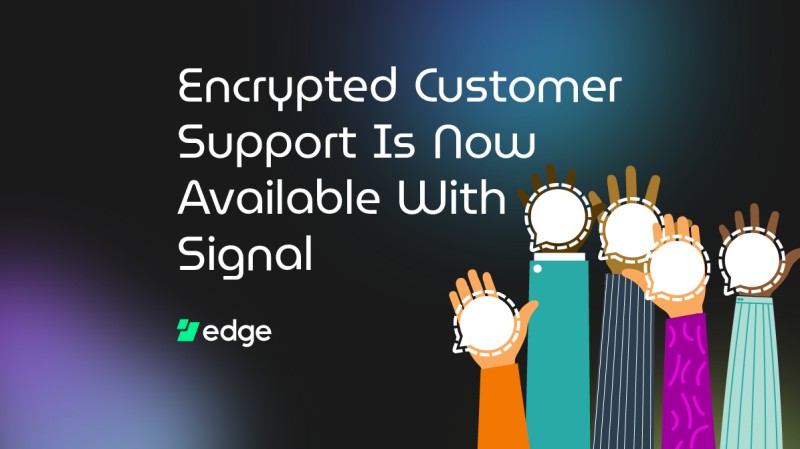
You message Edge's official Signal handle from the app or site. A real human replies, not a bot. They speak many languages, and phone help comes in English, Spanish, or Italian. It's the same fast support with more privacy.
No Edge employee will ever ask for your seed phrase, private keys, username, or password. If anyone does, it's a scam.
Hey, don't skip this part. If your wallet may be hacked, move funds to a new account right away. Encrypted chat is great, but your keys stay your job. Edge can't and won't grab them.
Paying With Crypto Using BitPay
Edge Wallet added BitPay support. You can pay from the app at checkout. BitPay is a payment protocol used by 100-plus wallets. Edge is non-custodial. You hold 130 assets, trade, buy, and spend. Backups are just username and password.
Steps to pay from Edge with BitPay
- Select BitPay at checkout
- Tap Begin Payment and verify BitPay ID if prompted
- Pick Edge Wallet from the list
- Choose your cryptocurrency
- Scan the QR code and send inside the 15-minute window
You can buy tickets, food, travel, and more. Newegg, APMEX, AMC, airBaltic, and PacSun take it. Some compare options like google trust wallet or trust wallet com , but Edge keeps the username-password backup simple.
For self-custody fans, coinbase self custody wallet gets talked up a lot. Edge is also self-custody. You control keys, not a company. And if you read a Robinhood Wallet review , check who holds the keys before you trust it.
Safest Ways to Hold Keys
People search safest online crypto wallet hoping for one answer. Truth is, online is hot storage, so it's convenient but exposed. Cold storage is safer. Edge is a middle ground: easy backup, keys on your device, encrypted by your password.
If you want a specific asset, you might look up ravencoin wallet or trust coin wallet . Edge supports many coins in one place. That cuts the number of apps you juggle. Less juggling means fewer mistakes.
Crypto Value Models
Folks want to price Bitcoin. Stock to flow compares existing supply to new flow. Gold is scarce, Bitcoin is getting closer. Total addressable market guesses if crypto eats part of gold, stocks, or bonds. These are rough maps, not truth.
Network value to on-chain transaction volume looks at price vs usage. High smoothed NVT hints a drop. Metcalfe's law says network value grows with users squared. None are perfect. Use them together, not alone.
Roll Your Own Crypto Debate
Some devs say "don't roll your own crypto." Others push back. Filippo Valsorda says scared devs ship bad tools because good ones aren't packaged well. Thomas says new crypto from non-cryptographers often breaks users. Both have a point.
Don't roll your own crypto alone, go with a friend.
Real coders and real cryptographers miss each other's skills. Good libraries help, but protocol joinery breaks even with safe parts. Cryptocurrency pulled in many new people, some with odd ideas. The debate stays open.
Quantum and the Future
Could a quantum computer break edge app crypto? Symmetric crypto is fine against it. Public key systems like RSA or ECDSA are at risk in theory. But strong asymmetric ciphers exist that resist quantum. And the threat isn't practical yet.
Researchers can move funds to quantum-resistant schemes later. The battle of codemakers and codebreakers continues. That's just how this field works. Stay calm, use good tools, and don't share your keys.
Why Edge App Crypto Feels Calmer Now
When I first read about edge app crypto, the words felt like a wall. But wallets are just key holders. Privacy is built from old math. Support can be private on Signal. Paying with BitPay is a few taps. FIO makes names human.
You don't need to trust a faceless team. With Edge, your password is the lock. With FIO, your name is the address. With BitPay, your coins buy real stuff. That's the whole trick. No panic required.

Comments on “The Edge App Crypto Wallet Explained, With Privacy and BitPay”
No comments yet. Be the first to share your thoughts.