
- Network fees (gas) paid to chain validators
- Service or swap markup inside the wallet
- Exchange trading fees split by maker and taker
- Spread fees baked into buy and sell price
- Withdraw and deposit fees on moving coins out
- Inactivity or account upkeep fees on some platforms
Comparing Swap, Gas, and Layer-2 Fees to Find Your Lowest Fee Crypto Wallet Fast
19 September, 2026
0 comments

Hunting for the Lowest Fee Crypto Wallet
Your wallet is eating coins like a goat eats socks. Quietly and meanly. I once paid a crypto fee that could have bought a small goat, a loud one. We compare swap, gas, and layer-2 costs so you can pick the lowest fee crypto wallet and skip the ripped-off feeling.
Finding the right storage often comes down to one question. Which crypto wallet has the lowest fees? Fees are not one flat rate. They are a mix of network cost, service markup, and fiat swap commission. A wallet that trims these can save you real money over time.
Why Fees Are Not Just One Number
The decentralized nature of crypto is about freedom. But moving it around is not free. When you buy, sell, or transfer on an exchange, charges show up. They seem small. They add up, especially if you trade a lot.
Little in this world is free. Crypto wallets are no exception. If you hold tokens, you face different kinds of fees. The problem is knowing what you pay for and not paying more than needed.
The decentralized nature of crypto is all about freedom – but ironically, moving it around isn’t free.
Types of Fees You Actually Pay
Network fees are paid to miners or validators. The wallet maker does not pocket these. Busy networks like Ethereum can swing gas fees hard. Layer-2 solutions give big discounts. Gas comes from the chain itself when you send on Ethereum, Solana, or Polygon.
Service or swap fees show up in wallets with built-in swaps. Some add 0.5% to 1% on top of the DEX price. Trimming these is key to low-cost care of your coins. Exchange trading fees use maker and taker models. Makers add orders to the book and usually pay less.
Common fee types
Swap and Gas Cost Differences
Many wallets let you swap one token for another. That is handy. But some take a cut. MetaMask puts internal swap fee at 0.875%. Coinbase Wallet is about 1.00%. Trust Wallet has a variable swap fee and works cheap on BNB Smart Chain.
Gas is the chain cost. Ethereum simple transfer is 21,000 gas. At 20 Gwei that is near $0.12. But when the queue is long, price jumps. Solana or Avalanche often cost less than Ethereum mainnet.
Gas fees fluctuate based on network traffic; Ethereum often charges more than lower-cost alternatives like Solana or Avalanche.
Layer-2 Discounts Matter
Layer-2 networks like Arbitrum or Base can be 90 to 99% cheaper than Ethereum mainnet. MetaMask on Arbitrum, Optimism, or Polygon gives a low-cost interface. Coinbase Wallet leans on Base. Bitget Wallet supports 100 plus chains with layer-2.
Use layer-2 when you can. Send when traffic is low. Late nights or weekends in big time zones often show low Gwei. Bitget Wallet lets you pick low priority gas if the transfer is not urgent.
Wallets With Low Fee Claims
Cwallet says zero transaction fees. No internal swap fees. No internal or external withdraw fees. No deposit fees. Lowest network fees via lowest gas limit. Internal moves with Cwallet ID are off-chain and skip gas. Telegram TON allows free USDT moves with no gas or service charge.
Guarda Wallet states it takes no extra commission. Only blockchain or exchange partner fees apply. Those partner swaps run about 0.5% per deal. Card buys through partners often cost 4 to 5%. Non-custodial wallets are free to get and hold. Hardware wallets cost $50 to $300.
Wallet fee notes
- Cwallet: zero internal fees, off-chain ID moves
- Guarda: no own commission, partner swap near 0.5%
- MetaMask: 0.875% swap fee, cheap on L2
- Trust Wallet: low BSC fees, variable swap
- Coinbase Wallet: ~1.00% swap, Base focus
- Bitget Wallet: low swap, 100+ chains, fee tune
Custody and Extra Charges
Most non-custodial wallets are free to download. They do not charge to receive or hold. Hardware wallets cost money up front. Custody wallets may add fees on top of needed minimums. Guarda says no added commission, only blockchain or partner fees.
EOS has no transaction fees. But you pay for wallet creation and use bandwidth from staked tokens. Bitcoin fees are satoshis per byte. Inputs are about 148 bytes, outputs 34, base 10. Check mempool before send. Empty queue means low fee clears fast.
Most non-custodial wallets are free to download and do not charge for receiving or holding.
Exchange Trading Fee Tiers
Coinbase Advanced uses tiers. Under $10K volume taker is 0.60%, maker 0.40%. At $100K to $1M taker 0.20%, maker 0.10%. Gemini ActiveTrader starts taker 0.40%, maker 0.20% under $10K. Kraken Pro founded in 2011 and launched in 2013 has similar tiers.
Binance.US has zero trading fee on tier 0 pairs that include Bitcoin. BNB cuts fees. Global Binance standard is 0.1%. Blockchain.com taker under $10K is 0.45%. eToro US builds 1% into crypto trade price. Robinhood is commission-free but takes spread and routing fee.
Exchange fee samples
- Coinbase: maker 0.40% at low tier, 0.10% high
- Gemini: maker 0.20% low, 0.08% near $1M
- Kraken: maker 0.25% low, 0.08% at $1M
- Binance.US: zero on tier 0 BTC pairs
- eToro: 1% in price, no separate tag
- Robinhood: spread fee, no flat commission
Spread and Withdraw Fees
A spread is the gap between buy and sell price. The exchange earns through that gap. It is often inside the price, not listed. Withdraw fees are usually flat or percent to cover network cost. Most deposits are free.
Some platforms charge inactivity or margin interest. Check the fee page before you park coins. A low swap fee means little if withdraw cost is high or spread is wide.
A spread is the difference between an asset’s buy (ask) and sell (bid) price.
Bitcoin and Ethereum Fee Math
Bitcoin fee is satoshis per byte. One BTC is 100,000,000 satoshis. Transaction size grows with inputs and outputs. More addresses mean more bytes and more fee. EOS uses no tx fee but stake for bandwidth.
Ethereum fee is gas limit times gas price in Gwei. One ETH is 1,000,000,000 Gwei. Simple send is 21,000 gas. At 20 Gwei cost is 0.00042 ETH. You do not need high gas when queue is short.
Chain fee facts
- Bitcoin: sat per byte, inputs ~148, outputs ~34
- Ethereum: 21k gas transfer, price in Gwei
- EOS: no tx fee, pay for creation and bandwidth
- Solana: low cost vs Ethereum mainnet
- Polygon: L2 cheap, works with MetaMask
- Arbitrum: L2, big discount vs mainnet
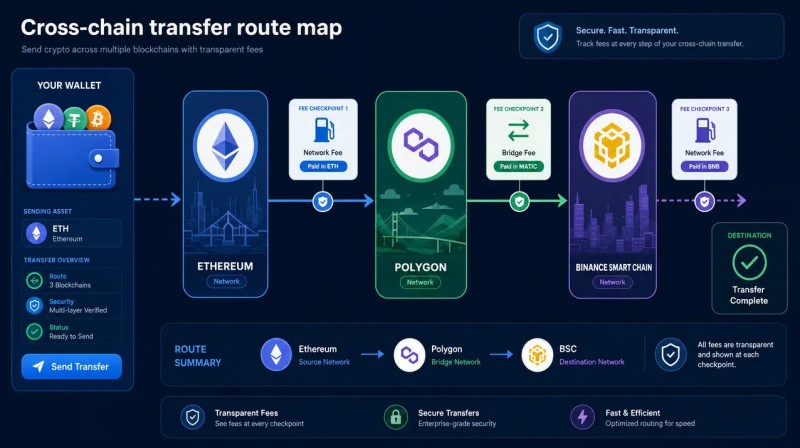
Cross-Chain Transfer Cost Checks
A cross-chain transfer moves value from one chain to another. Compare total received, not just the bridge fee shown. Bridge cost can include source gas, dest gas, approval gas, protocol fee, relayer, solver, liquidity, slippage, and failed tx cost.
FoxWallet is non-custodial and multi-chain with built-in cross-chain swaps. Before each transfer, compare total received across routes. Check both chain gases. Review bridge and slippage. Use a small test send on strange routes. Stop if wallet flags phish.
Cross-chain checklist
- Compare total amount received across routes
- Check source-chain and destination-chain gas
- Review bridge, relayer, solver, liquidity fees
- Review slippage and price impact
- Avoid extra swaps or bridge hops
- Use small test transfer for unfamiliar routes
Compare the total amount received on cross-chain routes rather than advertised bridge fee.
Worked Example of a Bridge Move
Say you move 1,000 USDC from Ethereum mainnet to Base. Advertised bridge fee 0.05% is $0.50. Approval plus bridge gas on mainnet may be a few dollars to $15 plus. On arrival you may need Base gas to use funds. Mainnet gas often dominates cost.
Starting from L2 funds can be cheaper even with higher headline bridge fee. Deep liquidity routes cost less. Split large trades to cut price impact. Verify contract approvals before sign.
Security Before You Save on Fees
Never enter seed phrase on a bridge site. Verify the URL. Review approval scope. Stop if wallet shows phish or bad contract. FoxWallet gives risk alerts but cannot promise safe exec. Cheap is not worth a drained wallet.
Use internal off-chain moves when both sides have the same wallet ID. Cwallet ID skips gas. Lightning Network gives zero-fee Bitcoin off mainnet. TON gives free USDT via Telegram with no gas or service charge.
Never enter seed phrase on bridge site; verify URL; review approval scope; stop if wallet flags phishing.
Ways to Cut Wallet and Exchange Cost
Use layer-2 networks. Arbitrum or Base can be 90 to 99% cheaper than Ethereum mainnet. Watch network congestion with gas trackers. Bitget Wallet lets you set low priority gas. Hold BGB for up to 20% discount or BNB to cut fees.
Trade in larger volume for lower tiers. Avoid frequent withdraws. Compare total received on cross-chain routes. Search platforms with sign-up discounts. Some partners take ~0.5% per deal vs up to 15% hidden in rate.
Cost cut steps
- Use Layer-2 like Arbitrum or Base
- Monitor gas trackers for low Gwei
- Manual low priority gas in Bitget Wallet
- Hold BGB or BNB for fee discount
- Compare total received not bridge fee tag
- Use off-chain internal transfer to skip gas
Where Some Free Options Show Up
You can look at places that talk about buying crypto without fees when you scan wallet blogs. Some posts ask where can i get free crypto and point to zero-fee internal moves. Watch for real limits before you trust the word free.
If you search google trust wallet you will see BSC cheap use. The site trust wallet com lists swap and network notes. For a simple phone tool some check edge app crypto or simplex crypto app for buy paths. And Robinhood Wallet review threads note spread cost not flat fee.
Places people look
- buy crypto without fees blogs and zero-fee claims
- where can i get free crypto giveaway posts
- google trust wallet for BSC low fee use
- trust wallet com for swap and network info
- edge app crypto as a mobile wallet option
- simplex crypto app for card buy routes
More Wallet Names People Ask About
Some want best apps for buying crypto with low spread. Others keep a ravencoin wallet for that chain and watch its small network cost. The phrase crypto with no fees gets used a lot but read the fine print on partner swaps and network gas.
I am not saying any one app is perfect. I am saying check the real total. A wallet can say no fee and still pass network gas or partner cut. The lowest fee crypto wallet is the one that shows you the full cost before sign.
The lowest fee crypto wallet is the one that shows you the full cost before sign.
Future Fee Shifts to Know
Account abstraction lets gasless tx where a dApp pays or you pay in USDT not native token. That removes need to hold small volatile coins for gas. Integrated ecosystems like Bitget UEX aim for low overhead with spot fees 0.01% maker taker and BGB discounts.
Institutional pressure pushes retail wallets to cut swap markup and improve gas guess. Morgan Stanley Bitcoin Trust launched with 0.14% annual fee, low among US spot Bitcoin ETFs. That tone trickles down to wallet fee clarity.
Fee trend notes
- Account abstraction pays gas in stablecoin
- Bitget UEX spot 0.01% maker taker
- BGB holders get up to 20% discount
- ETF fee pressure lowers retail markups
- Better gas estimate in wallets over time
- More L2 default routes in mobile wallets
My Take on Picking the Lowest Fee Crypto Wallet
I would start with what chain you use most. If it is BSC, Trust Wallet is nearly free there. If it is Ethereum, use L2 inside MetaMask or Coinbase Wallet on Base. If you move a lot between chains, FoxWallet or Bitget Wallet give route control.
Cwallet is worth a look for off-chain zero fee moves if both sides have ID. Guarda is clear that it takes no own cut. But partner swap is ~0.5% and card buy 4 to 5%. Read the real total, not the banner.
Read the real total, not the banner.
Quick Compare Table Notes
Bitget Wallet has low competitive swap and 100 plus chain support. MetaMask is 0.875% swap and high L2 support. Trust Wallet is variable swap and moderate L2. Coinbase Wallet is ~1.00% swap and Base focus. Cwallet claims zero internal fees.
On exchanges, Binance.US tier 0 is zero for BTC pairs. Kraken and Coinbase tiers drop near $1M volume. eToro builds 1% in price. Robinhood takes spread. Pick by your volume and chain, not by one line on a ad.
Side by side
- Bitget: low swap, fee tune, 100+ chains
- MetaMask: 0.875% swap, L2 cheap
- Trust: BSC near free, variable swap
- Coinbase W: ~1% swap, Base focus
- Cwallet: zero internal, off-chain ID
- Guarda: no commission, partner 0.5%
Don't Skip the Gas Check
Hey, don't skip this part. Gas is where the goat eats your socks. Check Gwei before Ethereum moves. Use L2 for daily stuff. Set low priority if not urgent. A small wait can save more than a bad swap rate.
For Bitcoin, check mempool size. Empty means low fee passes quick. For cross-chain, compare total received. Bridge fee tag is not the whole story. Failed tx can cost you twice.
Check mempool size; if empty, low fee passes quickly.
Final Notes on Low Fee Wallets
The lowest fee crypto wallet is not one name for everyone. It is the mix of swap cut, gas route, and L2 use that fits your habit. I compare swap, gas, and layer-2 fees so you can keep coins instead of feeding the blockchain barn.
Use the checklists. Test small. Read the real total. That is how you stop the quiet goat and hold your coins.
Related posts


Comments on “Comparing Swap, Gas, and Layer-2 Fees to Find Your Lowest Fee Crypto Wallet Fast”
No comments yet. Be the first to share your thoughts.